Project Profile
470 Leads Qualified Automatically in HubSpot with Zero Manual Research
Simple Strat built a lead qualification agent inside HubSpot using Breeze Studio and workflow automation, processing inbound contacts against scoring criteria and writing structured qualification notes directly to each contact record.

The Challenge
The client's BDR team had a volume problem. Hundreds of new records were being created every day and piling up as unqualified leads. Without qualification, leads don't get assigned to BDRs.
The options were assigned to dedicate someone to manually research each lead qualifying for fit and opportunity or wait for the contact to hit lead scoring thresholds, then go through manual evaluation.
Realistically, the backlog of leads was too large for either option to work quickly and effectively.
That manual research was eating 15 to 30 minutes per lead. Multiply that across hundreds of inbound contacts, and the problem wasn’t effort — it was math. The team couldn’t keep up without adding headcount, and even when they did keep up, the definition of qualified was not clearly defined. Different reps made different calls. High-potential leads sat in a queue. CRM notes were incomplete or missing altogether.
As lead volume grew, it became clear the answer wasn’t more people. It was a better system.
The Solution
Every output writes its findings back to the contact record, so when a sales rep opens a record, the research is already done. The whole thing runs on workflow automation, which means it fires the moment a contact is created.
The Setup
Simple Strat built a Lead Qualification Agent directly inside HubSpot using Breeze Studio. The customer research agent was repurposed to mirror the judgment a good BDR would apply, but do it automatically, consistently, and at scale, the moment a new contact hits the system.
The Engine
When a new contact is created, it enters a workflow triggering the agent automatically. It pulls company firmographic data, industry news, evaluates intent signals and engagement behavior, then checks the contact against defined ICP and qualification criteria. From there, it applies consistent scoring logic based on a custom decisioning map— flagging unqualified leads, identifying nurture candidates, and surfacing the high-fit, high-intent prospects that deserve immediate attention. It also provides guidance on the best way to reach out and a topic relevant to their best product fit.
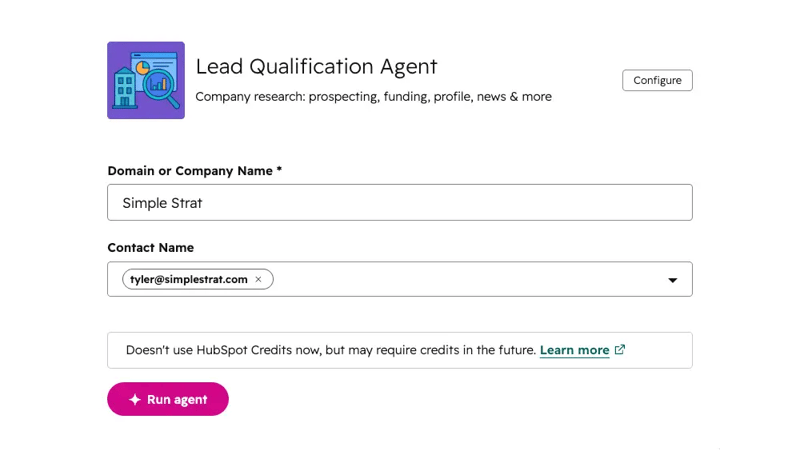
Input
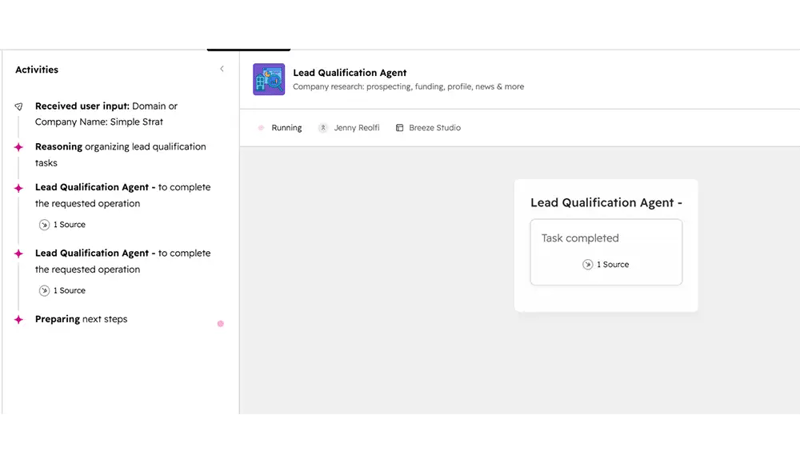
Researching
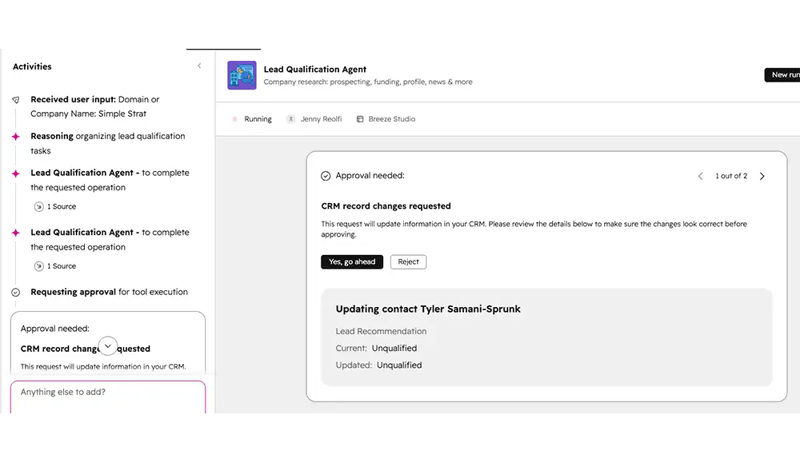
Approval
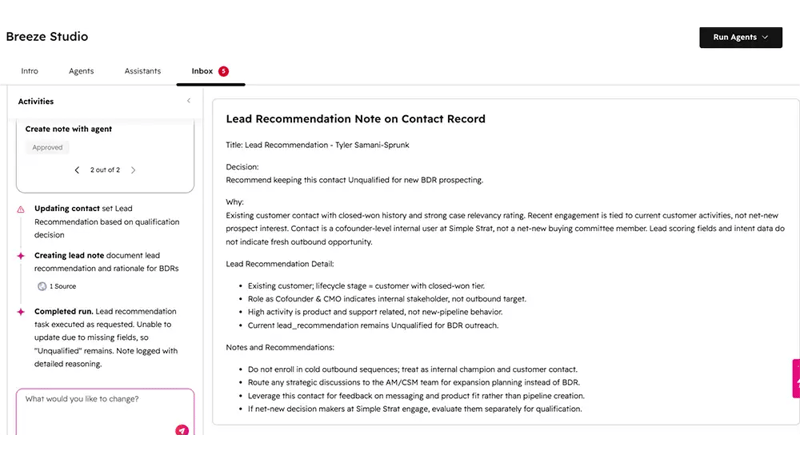
Completed Run
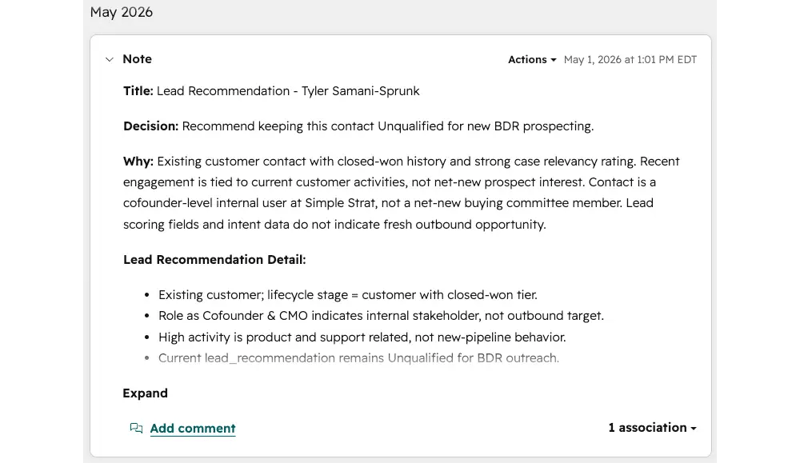
Note on Record
The Impact
In its first month, the agent processed 470 contacts. Of those, 129 were flagged as unqualified, 182 went into nurture, 127 were marked as good fit, and 32 were classified as high intent and handed off to sales immediately.
The time savings were just as significant. Manual lead qualification takes an industry average of 15 to 30 minutes per lead. Across 470 contacts, that adds up to somewhere between 117 and 235 hours of research time the team got back in a single implementation.
Beyond the hours recovered, the operational shift matters just as much. High-intent leads now get to sales faster. Every record gets the same evaluation criteria, regardless of which rep would have reviewed it. The CRM data is cleaner and more consistent. And the system scales with volume.
The time savings gave the BDR team room to breathe — but the bigger business impact was a system that ensures no qualified lead falls through the cracks.

FAQ
Can HubSpot automatically qualify and score inbound leads?
Yes — but native lead scoring is only as good as the data already in your CRM.
HubSpot's lead scoring tools assign point values to contact behaviors and properties, automatically surfacing the leads most likely to convert. However, if a contact submits a form with minimal information, the score reflects that gap.
A Lead Qualification Agent solves this by actively researching the contact and company before scoring begins — pulling from public web sources, recent news, and existing HubSpot records to enrich the record first.
The result is a decisioning matrix applied against a much fuller picture, reducing the chances a strong lead gets undervalued or a poor fit slips through. As a HubSpot Diamond Solutions Partner, Simple Strat builds these layered qualification systems for B2B teams that need more than native scoring can deliver.
How do you build AI agents in HubSpot, and what can they actually do?
HubSpot AI agents can qualify inbound leads end-to-end — pulling from your CRM and live web data, scoring against your criteria, and writing results directly to the contact record.
Building an AI lead qualification agent in HubSpot starts inside Breeze Studio, where you define your qualification criteria — firmographic fit, intent signals, and engagement thresholds — and structure those as custom contact properties. The agent draws from two sources simultaneously: existing HubSpot contact and company records, and live web research including company news and public firmographic data.
Those inputs run through a fit criteria matrix you define, then a decisioning matrix determines next steps — with results logged directly to the contact record as a formatted note and HubSpot properties updated automatically.
One important technical note: qualification documents are best stored in the knowledge vault to avoid character count limits. As a HubSpot Diamond Solutions Partner, Simple Strat has used this approach to help clients recover over 100 hours of manual BDR research time in a single implementation.
Is HubSpot Breeze Studio the right tool for automating lead qualification at my company?
If your team has defined what a qualified lead looks like and the volume is there, this is the right move. If qualification criteria are still being debated, the agent will automate the inconsistencies.
Breeze Studio is the right tool if your team is already using HubSpot at the Professional or Enterprise tier for Marketing, Sales, Service, Content, or Data Hub. Built natively into the platform, qualification agents can read and write to contact records, trigger via existing workflows, and surface recommendations inside the CRM your sales team already uses — with no integration layer to maintain and no data leaving the platform.
The tradeoff is that output quality depends heavily on how well your qualification criteria, ICP definitions, and CRM properties are structured before you build. For companies with messy data or undefined ICPs, the right first step is a data cleanup and criteria audit — not agent deployment. As a HubSpot Diamond Solutions Partner, Simple Strat regularly helps B2B teams assess whether their HubSpot foundation is ready for agent deployment before a single workflow is built.