Health Care
Managing Multiple Deal Renewal Types
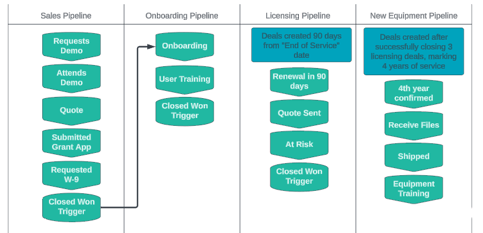
Simple Strat configured HubSpot Workflows and multiple deal pipelines to automatically create renewal deals 90 days before End of Service dates and trigger equipment upgrade deals every fourth renewal cycle, replacing a manual spreadsheet process that was missing deadlines and revenue opportunities.

The Challenge
The client’s renewal process was inefficient and risky. Managing cyclical deals with varying renewal timelines relied heavily on manual tracking, which led to missed opportunities and wasted time. Key issues included:
-
Renewal deals were triggered manually, often after deadlines, based on an arbitrary one-year post-sale timeline instead of clients’ actual “End of Service” dates.
-
Equipment upgrade deals, triggered every fourth renewal cycle, were difficult to track without cumbersome spreadsheets, leaving room for error.
The Solution
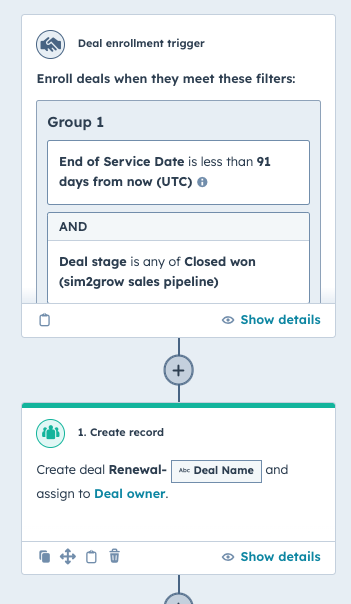
We automated the client’s renewal process by setting up workflows to create renewal deals based on End of Service dates, and track equipment upgrade cycles. This system automatically triggers renewals 90 days before a service ends and flags when equipment upgrades are due every fourth renewal, all without manual intervention.
The Impact
-
Eliminated the need for manual tracking of End of Service and Equipment replacement dates in spreadsheets.
-
Automated deal creation, saving time and ensuring no upcoming renewals or equipment upgrades were missed.
-
Provided real-time visibility into client renewal and equipment upgrade timelines.
-
Increased efficiency in managing complex renewal workflows, freeing up the team to focus on higher-value tasks.

FAQ
How can HubSpot automatically create renewal deals before a service contract expires?
A workflow enrolled on the End of Service date field will automatically create a new renewal deal in the correct pipeline 90 days before expiration.
The workflow monitors the date property on active deals and fires when the threshold is met, creating a new deal record pre-populated with the relevant account and service details. This gives the sales team a 90-day window to re-engage before the contract lapses, rather than discovering an expiring contract after the fact. For healthcare and service-based businesses managing large volumes of recurring contracts, automating this trigger is the difference between a proactive renewal motion and a reactive one that misses revenue.
Can HubSpot track equipment upgrade cycles that only occur every fourth renewal without a spreadsheet?
Yes — a custom property that increments with each renewal cycle, combined with a conditional workflow, can flag when the fourth cycle is reached and automatically create the equipment upgrade deal.
The logic works by tracking a renewal count property on the deal or company record. Each time a renewal workflow fires, it increments the count. When the count hits four, a separate workflow branch creates the equipment upgrade deal in its own pipeline. This removes the spreadsheet entirely. The system tracks the cycle internally and surfaces the opportunity at the right time without anyone monitoring it. Simple Strat, a HubSpot Diamond Solutions Partner, builds these multi-cycle renewal systems for healthcare and medical device companies that need their CRM to manage complex service cadences accurately and automatically.
What happens to renewal revenue when the sales team is manually tracking contract end dates in spreadsheets?
Deals slip. Not because the team isn't diligent, but because manual tracking at scale is unreliable, and the cost of a missed renewal is rarely visible until it's already gone.
Spreadsheet-based renewal tracking works until the volume of contracts outpaces the person managing the file. At that point, end dates get missed, renewal windows close, and the team is left trying to re-engage customers who've already made other arrangements. Moving renewal triggers into HubSpot workflows means every contract is monitored automatically, every deadline surfaces on time, and the team is working a live pipeline rather than a static list. For businesses where recurring revenue is a significant portion of total revenue, that reliability has a direct impact on retention and forecasting.