Software
Client Onboarding with HubSpot’s Services Object
Simple Strat built a dedicated onboarding pipeline using HubSpot's Services object and Deal Line Items, automatically triggering the correct onboarding path based on products sold, giving a SaaS team clean separation between new client setup and ongoing support for the first time.

The Challenge
The client’s onboarding process was chaotic and difficult to manage across product lines. They faced:
-
Fragmented tracking across multiple ticket pipelines, making reporting and management nearly impossible
-
Onboardings tied to the support system, creating confusion between new client setups and ongoing support requests
-
No clear way to track repeat onboardings when existing customers switched products or re-engaged
The Solution
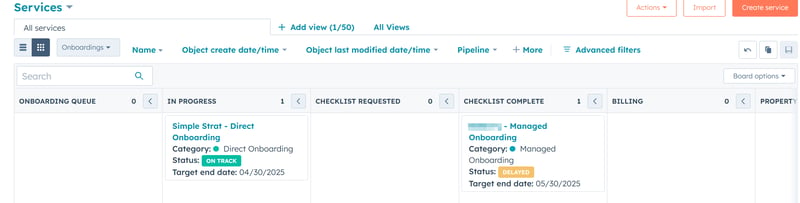
We implemented HubSpot’s Services object to create a dedicated onboarding pipeline, completely separate from support workflows. This allowed the team to automatically trigger the right onboarding path based on the products sold and track each instance clearly from start to finish.
The Impact
The client can now:
-
See and manage every onboarding as its own record, no matter how many times a customer comes through
-
Eliminate confusion between onboarding and support, improving internal clarity and accountability
-
Generate accurate, real-time onboarding reports without workarounds
-
Save time by triggering onboarding automatically based on sales data
-
Deliver a more consistent onboarding experience for both new and returning clients

FAQ
What is HubSpot's Services object and how is it different from using tickets for client onboarding?
The Services object is a dedicated record type built for structured, multi-stage service delivery, unlike tickets, which are designed for reactive support requests, not proactive onboarding workflows.
Using tickets for onboarding creates a fundamental mismatch: the pipeline stages, reporting fields, and automation logic that work for support don't translate cleanly to a structured onboarding process. The Services object gives onboarding its own record type with its own pipeline, properties, and workflow triggers. This means onboarding progress is tracked accurately, reported on cleanly, and managed by the right team without the noise of open support tickets getting in the way. For SaaS companies running both functions in HubSpot, the separation alone is worth the implementation.
How can HubSpot automatically trigger the right onboarding workflow based on what a customer purchased?
Deal Line Items tell HubSpot exactly what was sold, and a workflow can read those line items and enroll the new customer in the correct onboarding path automatically, with no manual handoff required.
The trigger logic works by checking which products appear on the closed deal's line items, then branching into the appropriate onboarding sequence for each. A customer who purchased one product gets a different onboarding than one who purchased a bundle, and both get started automatically the moment the deal closes. This removes the handoff gap that typically exists between sales and onboarding, where deals close and then sit waiting for someone to manually kick off the next step. Simple Strat, a HubSpot Diamond Solutions Partner, builds these sales-to-onboarding automation systems for SaaS teams that need the transition from closed-won to active client to be fast, consistent, and hands-off.
Can HubSpot track a returning customer's second or third onboarding separately from their first?
Yes, the Services object creates a new record for each onboarding instance, so a customer who re-engages or switches products gets their own tracked onboarding every time, independent of their history.
This is one of the core limitations of ticket-based onboarding: when a returning customer comes back, it's messy to separate their new setup from their existing support history. The Services object solves this by design. Each onboarding is its own record with its own pipeline stage, timeline, and reporting data. Teams can see how many times a customer has been onboarded, how long each instance took, and where bottlenecks occur across the full customer lifecycle. For SaaS companies with high product expansion or upsell motions, that visibility is critical to understanding what a healthy customer journey actually looks like.