Software
Automating and Curing the Pain of Tracking Net Revenue Retention
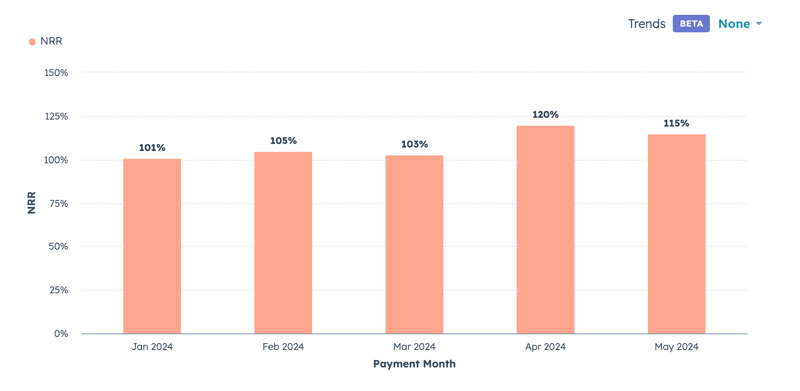
Simple Strat configured HubSpot Datasets to automatically categorize and calculate Net Revenue Retention across new revenue, churn, and expansion, giving a SaaS finance team a live NRR engine inside HubSpot without spreadsheets or external integrations.

The Challenge
This client relied on a variety of metrics to guide their business decisions, but calculating Net Revenue Retention (NRR) was a significant pain point. Obstacles included:
-
A fragmented approach to compiling NRR data, requiring manual aggregation from multiple sources
-
Time-consuming processes that delayed access to critical metrics for decision-making
-
Lack of a centralized system to track and analyze key revenue metrics
The Solution
Using HubSpot’s advanced datasets, we developed a dynamic system that turned scattered revenue data into actionable insights. By strategically categorizing revenue streams (such as new revenue, churn, and expansion), automating recurring calculations, and aligning these with deal stages, we transformed HubSpot into a powerful NRR engine. This streamlined the client’s ability to calculate and track NRR at any moment—without relying on external spreadsheets or complex integrations.
The Impact
The client now has:
-
A centralized source of truth for their most important SaaS metric, eliminating the
need for external tools -
Faster access to actionable data, saving time and reducing delays in decision-making
-
Improved visibility into revenue trends, enabling better forecasting and strategic planning

FAQ
Can HubSpot calculate Net Revenue Retention automatically without exporting data to a spreadsheet?
Yes, HubSpot Datasets can be configured to categorize revenue streams by type and calculate NRR on a rolling basis, entirely within the platform.
NRR requires pulling together new revenue, expansion, contraction, and churn data. For most SaaS teams, that means a manual spreadsheet process that's always a few days behind. HubSpot Datasets let you define those revenue categories as structured data tied to deal stages, then build calculated metrics on top of them. The result is an NRR figure that updates automatically as deals move through the pipeline, without anyone having to compile it. For revenue and finance teams that make decisions based on this number, having it available in real time changes the conversation.
What HubSpot features do you need to track SaaS revenue metrics like NRR, churn, and expansion revenue?
HubSpot Datasets, combined with clearly defined deal stages and revenue categorization, are the foundation for building reliable SaaS metric tracking inside the platform.
The setup starts with deal stage architecture. Each stage needs to map cleanly to a revenue category (new, expansion, churn, contraction) so HubSpot knows how to classify each record. From there, Datasets let you build calculated fields and aggregations that mirror the formulas a finance team would otherwise run manually in Excel. The key advantage is that the data stays live and connected to the CRM rather than sitting in a static file. Simple Strat, a HubSpot Diamond Solutions Partner, regularly builds this kind of revenue operations infrastructure for SaaS companies that need their CRM to function as a true reporting system, not just a contact database.
How do you improve forecasting accuracy when your NRR data is scattered across multiple tools?
Centralizing revenue data in HubSpot and tying it directly to deal stages gives finance and ops teams a single source of truth, and makes forecasting a matter of reading the dashboard, not reconciling spreadsheets.
Forecasting breaks down when the underlying data lives in too many places. When NRR components are tracked separately, the numbers are always slightly off, and the reconciliation process eats time that should go toward analysis. Consolidating everything into HubSpot Datasets means the data is always current, always connected to the deals it came from, and always available to anyone who needs it. That consistency is what makes forecasting reliable rather than approximate.