Financial / Insurance
Automated Commission Tracking for Complex Payouts
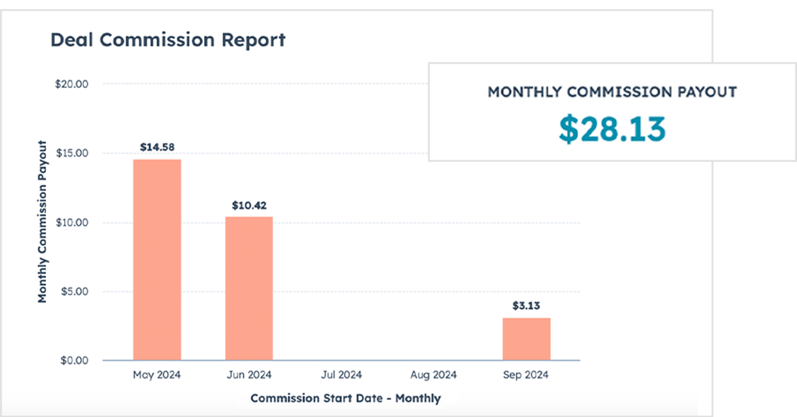
Simple Strat built Calculated Properties in HubSpot that automatically compute monthly commission payouts by fund type and schedule incremental disbursements over 36 months, replacing a manual Excel process and consolidating all commission data into a single deal-level view.

The Challenge
The client needed a simpler way to calculate and track commissions for different fund types, with varying commission rates and payout schedules. Payments had to be disbursed incrementally over 36 months, which previously involved manually tallying data each month using Excel and pulling information from multiple systems—resulting in a time-consuming and error-prone process.
The Solution
We built an automated system in HubSpot to handle the client’s commission calculations. We made commission tracking automatic for each fund type and scheduled incremental payouts over 36 months. This upgrade replaced their old Excel process and pulled all commission data into one easy, centralized view.


The Impact
The client can now:
-
Automatically calculate commissions based on fund type, eliminating manual work
-
Track monthly payouts over 36 months in a single system
-
View up-to-date commission totals for each deal at a glance
-
Get accurate commission payments with reduced risk of human error

FAQ
Can HubSpot automatically calculate commissions when the rate varies by fund type or deal structure?
Yes — Calculated Properties can apply conditional logic to compute the correct commission amount based on any deal property, including fund type, eliminating the need for manual formulas or spreadsheets.
The calculation runs automatically every time the relevant deal data changes, so commission figures are always current without anyone having to update them manually. For organizations managing multiple fund types with different rate structures, this means one consistent system handles the math across every deal. The output is available directly on the deal record, visible to anyone who needs it, and reportable without an export. This is especially valuable for finance teams who previously spent hours each month reconciling commission data across disconnected tools.
How do you track incremental commission payouts over a multi-year schedule inside HubSpot?
Calculated Properties paired with Custom Reports can break a total commission figure into scheduled monthly amounts and display running payout totals at the deal level without external spreadsheets.
The approach treats each monthly payout as a calculated value derived from the deal's commission total and schedule, rather than a manually entered figure. Custom Reports then aggregate those values across all active deals, giving finance teams a real-time view of what's been paid and what's upcoming. For payout schedules stretching 36 months or longer, this replaces what was previously a multi-step manual process involving multiple systems. Simple Strat, a HubSpot Diamond Solutions Partner, builds these commission automation systems for financial services firms that need their CRM to handle complex payout logic reliably and at scale.
What's the risk of managing long-term commission schedules manually in Excel?
Manual commission tracking is one of the highest-risk administrative processes a finance team can own. Errors compound over time, and the longer the payout schedule, the more opportunities there are for something to go wrong.
When commission data lives in spreadsheets, accuracy depends entirely on the person maintaining them. A missed row, a formula error, or a formula that doesn't account for a new fund type can produce incorrect payouts that take months to catch. Moving commission calculations into HubSpot eliminates the manual step entirely. The system computes the correct figure based on deal data, every time, with no human intervention required. For businesses disbursing payments over multi-year schedules, that reliability is the difference between a process that runs quietly in the background and one that generates constant corrections and disputes.