Project Profile
Turning a Broken Salesforce Sync Into a Structured Referral System
Simple Strat built a HubSpot Custom Object architecture with calculated referral URL properties to give a healthcare client clean, trackable referral data across their HubSpot-Salesforce integration.

The Challenge
This healthcare client grows through referrals — patients referring other patients, physicians referring patients — and that referral network is their primary growth engine. But for a long time, there was no reliable way to track it.
The complicating factor: HubSpot was already integrated with Salesforce. The standard workaround — using association labels to link contacts — technically functioned inside HubSpot, but associations synced to Salesforce without any meaningful context. A referred contact would arrive on the Salesforce side stripped of everything that mattered: who sent them, what type of referral it was, and what action should follow. No referrer-referral distinction. No volume reporting. No automated follow-up.
The data was moving. The meaning wasn't.
The Solution
The standard fix of forcing referral relationships into association labels wasn't going to work here. Associations lack the structure needed to carry context across a Salesforce integration, and they can't support meaningful reporting or automation on their own. A dedicated data model was needed.
The Setup
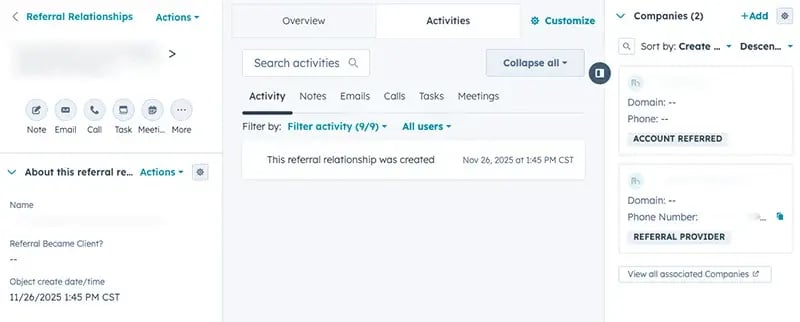
Simple Strat introduced a Custom Object for Referrals, giving each referral instance its own record with full context: referral type (patient-to-patient or physician-to-patient), activity counts, and referral history per contact. Rather than inferring relationships from associations, the system now has a structured source of truth that both HubSpot and Salesforce can work from.
The Engine
To automate referral capture, Simple Strat built a unique referral link system using calculated properties. Each physician is assigned a URL generated from their HubSpot record ID. When a patient submits through that link, HubSpot automatically creates the referral record, associates the correct referrer, and stores the full relationship with context intact, all without manual entry.
There was also a HIPAA constraint to solve for: referral links needed to identify the physician without exposing any patient data. Using the record ID as the URL basis addressed this directly — each link is unique and trackable, but carries no personally identifiable information.
The Impact
What was previously an unreliable, context-free sync is now a structured referral system of record.
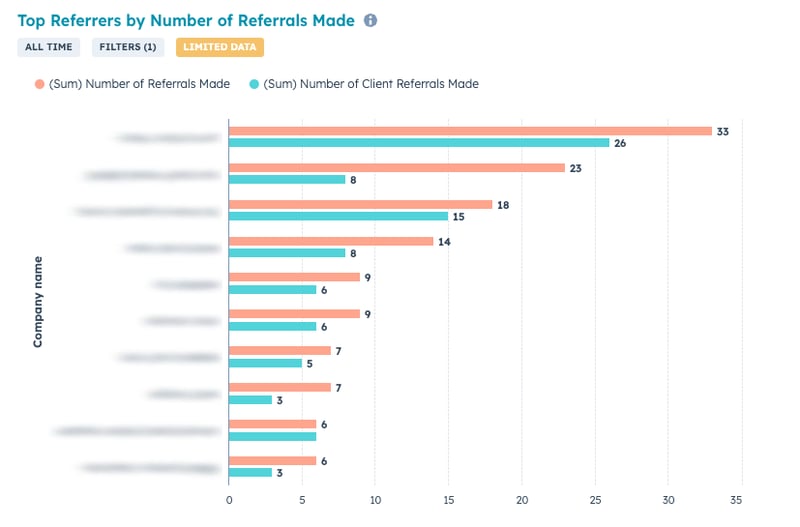
Salesforce receives meaningful data — not stripped associations it can't interpret. The referral object lives in HubSpot, where it powers reporting and automation without creating noise downstream. The team can now track referral volume by contact or physician, trigger workflows based on referral activity, and identify which sources are actually driving new patients. The manual reconciliation is gone. The data has the context it always needed.

FAQ
Can HubSpot automatically assign unique referral links to contacts or physicians?
Yes — and once it's set up, every new physician and patient gets one automatically without any manual work.
HubSpot's calculated properties can generate unique referral URLs dynamically using a contact's record ID, eliminating the need to manually create or distribute tracking links. This system was built to handle referrals from both physicians and patients — and on the patient side, HIPAA anonymity requirements meant referral links needed to identify the referrer without exposing any personal information. Using the record ID as the basis for the calculated URL solved for this directly: each link is unique and fully trackable, but contains no identifying patient data. When someone submits through that link, HubSpot automatically creates the referral record, associates the correct referrer, and stores the full relationship context. As a HubSpot Diamond Solutions Partner, Simple Strat designs these systems to be both compliant and scalable — so they work reliably from day one without ongoing manual intervention.
How do you track referral sources in HubSpot when contacts are syncing to Salesforce?
The answer isn't always syncing more data — sometimes it's being deliberate about what you keep in HubSpot.
When HubSpot contacts sync to Salesforce, standard contact-to-contact associations can create noise on the Salesforce side — arriving without context or relationship clarity. In this case, the right architectural decision was to build referral tracking on a dedicated HubSpot Custom Object and intentionally prevent those referral associations from syncing to Salesforce. This keeps the referral system clean and structured within HubSpot, where it can power reporting and automation, without introducing messy or uninterpretable data into Salesforce. The result is a clearer separation of concerns: Salesforce gets the contact data it needs, and HubSpot owns the referral relationship layer.
How does a HubSpot Diamond Solutions Partner approach custom object architecture for complex sales or referral processes?
They design with the end in mind — so the system you build today can prove its value tomorrow.
Custom Objects add complexity to HubSpot, and that tradeoff is only worth it if the architecture is built to deliver measurable business outcomes from the start. For healthcare organizations managing physician and patient referral networks, the goal isn't just to track referrals — it's to drive more referral business and have the data to prove it's working. Simple Strat can design the Custom Object schema with specific properties built in to support referral volume reporting, so leadership can see which referral sources are performing and make decisions accordingly. As a HubSpot Diamond Solutions Partner, Simple Strat doesn’t just build for the immediate problem — they build so the system can show its own ROI.