Project Profile
Equipment Lifecycle Management Made Easy
Simple Strat configured HubSpot's Listings object as a custom equipment record, building associations to Company, Deal, and Contact records so a manufacturing team could track serial numbers, payoff dates, and service history entirely within HubSpot.

The Challenge
The client needed a more effective way to track and manage their equipment inventory. They faced:
-
Disorganized data stored in Excel, making it difficult to track key details like serial numbers, shipping dates, and payment statuses.
-
Limited visibility into which machines were associated with which customers, slowing down customer service and sales opportunities.
-
Missed revenue opportunities from not identifying when leases or purchases were approaching payoff or service renewal dates.
The Solution
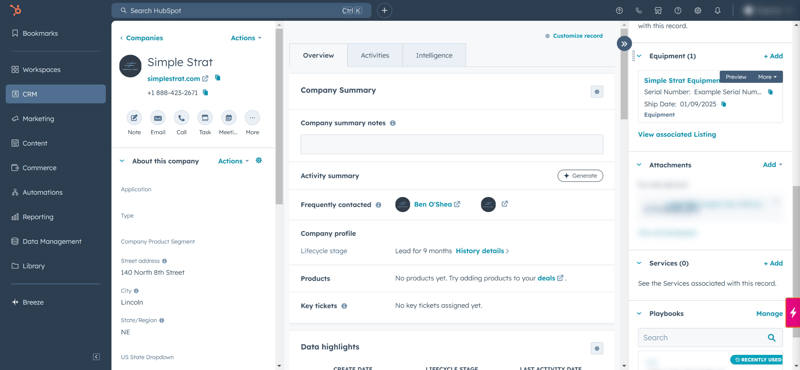
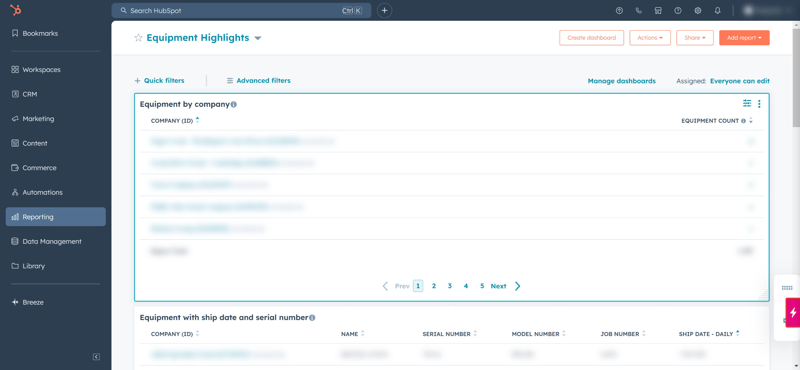
We retooled HubSpot’s Listings object to serve as a custom “equipment” object, creating fields and workflows that allowed each piece of equipment to be attached to companies, deals, and contacts. This centralized system now provides the client with an intuitive way to track and manage their inventory, all within HubSpot.
The Impact
The client can now:
-
Instantly see which equipment is associated with any company or contact, streamlining internal operations and improving customer service.
-
Proactively identify and target customers approaching payoff dates for upsell opportunities.
-
Seamlessly manage service upsells with clear visibility into which accounts need attention, boosting revenue potential without additional tools or spreadsheets.

FAQ
Can HubSpot track physical equipment or inventory tied to specific customers and deals?
Yes, HubSpot's Listings object can be configured as a custom equipment record and associated directly with Company, Contact, and Deal records.
HubSpot wasn't built as inventory software, but its custom object framework is flexible enough to handle equipment tracking when configured correctly. By retooling the Listings object, each piece of equipment gets its own record with fields for serial numbers, shipping dates, payment status, and lease terms linked to the relevant customer and deal. Sales reps and service teams can pull up a company record and immediately see every machine associated with that account. For manufacturers managing equipment across a large customer base, this eliminates the spreadsheet dependency that typically makes this data unreliable.
How do you proactively identify upsell opportunities based on equipment payoff or lease renewal dates in HubSpot?
Custom date properties on equipment records, combined with HubSpot workflows, can automatically flag accounts approaching payoff and trigger the right sales action.
Once lease end dates and payoff milestones are stored as structured fields on equipment records, workflows can monitor those dates and notify the assigned rep when a renewal window opens. This turns what was previously a missed opportunity into a repeatable sales motion. The key is having the data in HubSpot in the first place, associated to the right company and deal, so the workflow has something accurate to act on. Simple Strat, a HubSpot Diamond Solutions Partner, builds these kinds of lifecycle-aware systems for B2B teams that need their CRM to drive revenue, not just record it.
What's the advantage of managing equipment records inside HubSpot instead of a separate spreadsheet or system?
Everything stays connected — equipment history, customer relationships, open deals, and service activity all live in one place instead of being scattered across tools that don't talk to each other.
When equipment data lives in Excel, it's only as current as the last person who updated it, and it has no relationship to the customer record, the open deal, or the service history. Moving that data into HubSpot means every team member is working from the same source of truth, and any update to an equipment record is immediately visible to sales, operations, and service. It also makes reporting far more reliable, since you're pulling from structured CRM data rather than manually maintained spreadsheets. For operations-heavy businesses, that single source of truth is often the difference between proactive account management and constant firefighting.