Project Profile
Driving Sales with Equipment Lifecycle Visibility
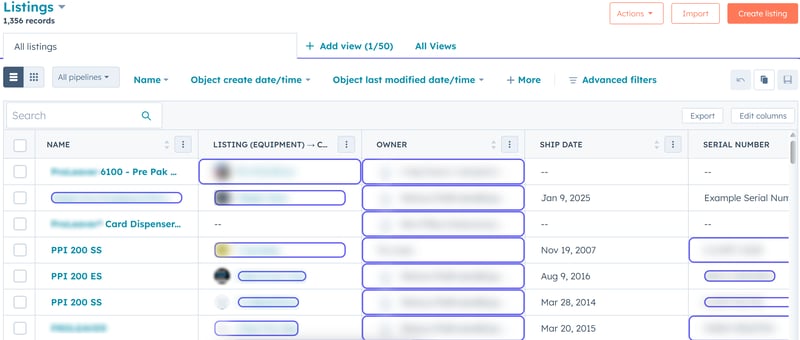
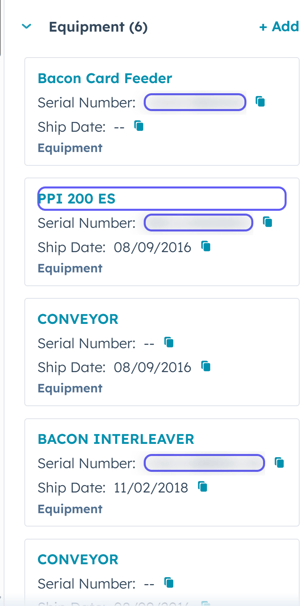
Simple Strat repurposed HubSpot's Listings object into a live equipment and asset tracking system, associating every unit to its customer record with ship dates, service intervals, and payoff timelines built in.

The Challenge
The client builds and ships their own equipment, but had no scalable way to track it post-sale, or tie it back to upsell opportunities. They struggled with:
-
Managing all equipment data in spreadsheets controlled by one person, creating bottlenecks and risk
-
No visibility into where equipment was in its lifecycle—making it hard to time service or upgrade conversations
-
Missing key upsell moments when customers finished paying off equipment or hit service milestones
The Solution
We repurposed HubSpot’s new Listings object to serve as a live inventory and asset tracking system. Each piece of equipment is now automatically logged and associated with the customer, with critical data like ship dates, service intervals, and payoff timelines built in. Sales and service teams get alerts when there’s an opportunity to engage.
The Impact
The client can now:
-
View every shipped unit and its lifecycle status inside HubSpot
-
Spot high-value upsell moments—like payoff completions or upcoming service needs
-
Eliminate manual tracking in spreadsheets and reduce single-person dependency
-
Equip both sales and service teams with shared, real-time insight into customer assets

FAQ
How can a manufacturing company track shipped equipment and service history inside HubSpot?
HubSpot's Listings object can be repurposed as a custom equipment record, associated directly to the customer, with fields for serial numbers, ship dates, service intervals, and payoff timelines.
Most manufacturers default to spreadsheets for post-sale equipment tracking, which works until the person maintaining that spreadsheet leaves, or the data gets out of sync with what's actually in the field. By building equipment tracking inside HubSpot, every unit is tied to the customer record it belongs to, visible to both sales and service without anyone having to ask. Updates happen in one place and reflect everywhere. For companies shipping dozens or hundreds of units, this is the foundation that makes proactive account management possible.
Can HubSpot automatically alert sales reps when a customer's equipment is approaching a payoff or service milestone?
Yes, workflows built on date-based properties in the Listings object can trigger rep notifications or enrollment in a sequence the moment a payoff or service window opens.
The workflow monitors the date fields on each equipment record and fires when the threshold is met. The rep gets notified, or the contact gets enrolled in a follow-up sequence, based on whatever logic fits the sales motion. This turns equipment lifecycle data from a passive record into an active revenue driver. Simple Strat, a HubSpot Diamond Solutions Partner, builds these workflow systems for manufacturers who want their CRM to surface the right opportunity at the right time, rather than waiting for a rep to remember to check.
What's the risk of keeping equipment data in spreadsheets instead of a CRM like HubSpot?
Single-person dependency is the biggest risk. When one person owns the spreadsheet, the whole system breaks the moment they're unavailable or gone.
Spreadsheet-based tracking creates a bottleneck by design. Access is limited, updates require manual effort, and there's no connection to the customer relationship or open deals sitting in the CRM. When that data lives in HubSpot instead, it's visible to every team member with access, tied to the accounts and contacts it belongs to, and available for reporting without anyone having to compile it. For sales and service teams working the same accounts, shared real-time visibility is what separates a coordinated handoff from a missed opportunity.